

A business systems audit should start with a clear objective, not a software checklist. It examines an organisation’s systems, processes and controls to assess how well they support day-to-day work, manage risk and meet relevant requirements. This can include whether technology is fit for purpose, who has access, how workflows operate and whether data is handled consistently.
An audit should do more than identify technical weaknesses. A clearly defined scope can also reveal where processes slow down, controls need attention or systems no longer support business priorities. This article explains what a business systems audit assesses, how it can support compliance, security and operational performance, and how to set objectives that make the findings useful. It also covers practical next steps for turning those findings into a clearer, more workable system.
Key Takeaways
- Set audit objectives around a practical outcome, such as finding process delays, duplicated tools or control gaps.
- Use CISA as a relevant professional credential to consider when assessing an IT auditor’s experience.
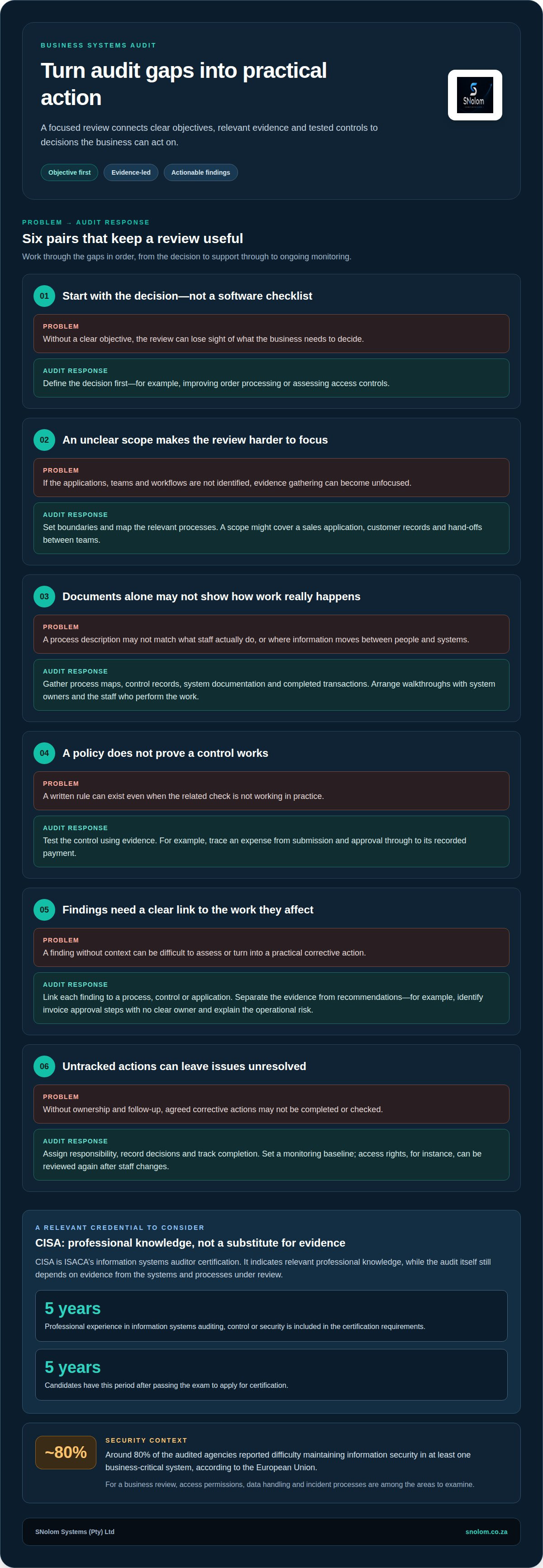
- Around 80% of the audited agencies reported difficulty maintaining information security in at least one business-critical system, according to the European Union.
- When findings point to a need for a more workable operating system, SNolom Systems (Pty)’s Business System Build can help turn defined requirements into a practical setup.
What is an audit of business systems?
A business systems audit examines processes, applications, data and controls to assess how well they support work. CISA is a professional credential relevant to information systems auditors, but it does not replace a clearly defined audit scope.
Audit reporting and remediation
A useful report links each finding to a process, control or application. For example, it might show that invoice approval steps have no clear owner and explain the resulting operational risk. The report should separate evidence from recommendations and identify practical corrective actions. The business can then assign responsibility, record decisions and track whether each agreed action is completed.
Reporting should also establish a baseline for ongoing monitoring. For example, access rights can be reviewed again after staff changes. Regular checks help maintain visibility of unresolved issues and show whether a revised process works as intended.
Audit steps
A business systems audit involves defining objectives and scope, mapping relevant processes, gathering evidence, testing controls, documenting findings, and agreeing on remediation and monitoring. The scope might cover a sales application, customer records and hand-offs between teams. This sequence gives the auditor a basis for assessing both system behaviour and how the business uses it.
CISA is ISACA’s information systems auditor certification. Its requirements include five years of professional experience in information systems auditing, control or security. Candidates have five years after passing the exam to apply for certification. The credential indicates relevant professional knowledge, but the audit still depends on evidence from the systems and processes under review.
Audit preparation
To prepare, define the decision the audit should support, such as improving order processing or assessing access controls. Then identify the applications, teams and workflows in scope. Gather process maps, control records, system documentation and examples of completed transactions. These materials help the auditor understand how work should happen and compare it with actual practice.
Arrange access to relevant system owners and the staff who perform each process. A short walkthrough of customer onboarding, for example, can reveal where information is entered, transferred or approved. Clarify who can provide records and explain exceptions. This preparation keeps evidence gathering focused on the audit objectives.
Compliance, security and operational benefits
A focused review links control gaps to practical effects on security and daily operations. Its value depends on a clear scope, relevant evidence and findings that lead to action.
Around 80% of the audited agencies reported difficulty maintaining information security in at least one business-critical system, according to the European Union. For a business, reviewing access permissions, data handling and incident processes can expose weaknesses before they disrupt customer service or routine work. It can also show where manual checks create avoidable delays.
Audit types
An internal audit supports the organisation’s own oversight, helping managers assess controls and operations. An external audit provides an independent perspective. A compliance audit focuses on whether defined practices align with applicable requirements. The key distinction is purpose: reviewing approval controls differs from assessing information security. The scope should match the decision the business needs to make.
Resource demands depend on the number of applications, teams and processes involved. Complex systems may require more evidence and specialist skills, so clear boundaries help keep the work focused.
Controls and compliance frameworks
Internal controls include approval steps, access restrictions and checks that help protect the accuracy of business records. An auditor can test whether these controls work in practice, rather than simply confirm that a policy exists. For example, a review might trace an expense from submission and approval through to its recorded payment.
Frameworks such as COBIT, ISO 27001 and NIST can guide the review, depending on its scope. They provide reference points for assessing controls, but the selected framework should fit the organisation’s risks and obligations.
In South Africa, audit costs depend on the scope, system complexity, applications reviewed, evidence required and reporting depth. Pricing is provided after a quote request.
The duration depends on access to records, the number of systems and processes, and how quickly staff can provide evidence. A narrow application review takes a different level of effort from a complex assessment across several teams.
Choose an auditor whose experience matches the systems and risks in scope. Agree the objectives, evidence requirements, reporting format and remediation process beforehand. Resource planning matters too: assign staff who understand each process, so interviews and document requests don’t stall. For findings that require a redesigned operating setup, a Business System Build can address the underlying workflow.
IT system audit definition and purpose
An IT systems audit assesses whether technology controls and infrastructure support reliable business operations. Its findings help leaders address technical risks and identify where system behaviour affects everyday work.
Purpose of an IT systems audit
The review examines whether technology is protected, available and managed in line with business needs. An auditor may assess networks, firewalls, backups, patching, endpoint security, disaster recovery and user provisioning. Together, these areas show how the organisation protects systems, restores access after disruption and manages who can use business information.
Evidence matters more than a policy statement. For example, an auditor can inspect backup records and assess whether recovery procedures are documented. They can also examine user access records to identify accounts that no longer match current responsibilities. These checks help management prioritise corrective work instead of treating every technical issue equally.
A business systems audit may include this technical review alongside application controls and the processes that rely on them. Clear communication among auditors, system owners and business teams helps explain how technical findings affect operations. The report should link each risk to an action, an owner and a way to monitor progress.
IT systems and business process audits
An IT systems audit focuses on technology foundations such as network security, backups and user access. A business process audit examines how work moves between people and tasks. For example, an IT review may assess access to a sales application, while a process review follows a customer order from receipt to fulfilment.
The distinction is useful, though the work can overlap. An information systems review may test application controls, workflow logic, data integrity and automation. It may also consider how staff use the system in practice. A sales workflow can be technically sound yet still cause delays if approvals are unclear or information is entered repeatedly.
Choose the focus according to the problem being investigated. A suspected security weakness calls for technical testing; repeated hand-off delays call for process analysis. If both are concerns, a combined scope can trace how system controls and staff actions affect the same outcome.
Business system audit objectives
A business systems audit is most useful when it starts with a decision the business needs to make. Clear objectives focus the review on measurable operational outcomes, not software descriptions alone.
Audit aims
Set an objective around a specific friction point: shorten process cycle time, reduce errors, identify overlapping software or assess employee productivity. Each objective changes which evidence matters. A review of customer experience, for example, can examine website usability and recurring customer pain points.
Choose a measure that reflects the intended outcome. Process cycle time can show whether a workflow is moving faster, while error rates can reveal where work needs correction. Customer satisfaction scores can add context when the objective concerns service quality. Record the starting position and define what findings would prompt a decision.
Keep objectives distinct. “Improve operations” is too broad to guide testing. “Find duplicated data entry between sales and fulfilment” points to specific tasks, systems and staff discussions. This clarity makes findings easier to prioritise and recommendations easier to assign.
Risks and weaknesses identified
A business systems audit can identify control gaps, unreliable data, duplicated processes and software that no longer supports the work. It can also reveal unclear ownership, repeated manual entry or hand-offs that leave requests waiting. These weaknesses can increase errors, delay responses or make performance harder to assess.
For example, if two teams maintain separate customer records, the audit can trace where the information diverges and which process causes the mismatch. If managers cannot see why cases remain open, reviewing workflow steps and reporting can reveal missing status updates. Each finding should link the observed weakness to its operational effect.
Use the findings to rank corrective work by business impact and dependencies. A data-quality issue affecting several reports may need attention before those reports can guide decisions. A business systems audit can also help assign an owner and follow-up measure to each recommendation, making corrective work trackable.
If the findings point to a need for a more structured operating system, explore a Business System Build to turn defined requirements into a practical setup.
SNolom Systems (Pty): Business System Build
SNolom Systems (Pty) Ltd can turn audit findings into a practical operating system when workflows, records or reporting need clearer structure. A business systems audit often highlights areas where a dedicated Business System Build is suited to businesses that need connected processes organised around defined operational requirements.
For a contained starting point, Guided Quick-Start establishes a working foundation. Workflow & Automation Build addresses repetitive steps by organising them into a clearer workflow. Data & Reporting Setup helps create a more consistent view of business information. The right option depends on the problem identified and the scope of work required.
These services focus on practical systems and implementation, without promising that every audit finding will disappear. Contact SNolom Systems (Pty) Ltd to discuss the process friction you want to address and the next suitable step.
Turn the findings into a workable next step
A business systems audit is most useful when its findings support a defined decision. Separate control issues from process improvements, then assign an owner to each action. This keeps the response proportionate, since not every observation requires a rebuild.
If the review identifies disconnected workflows or unclear reporting, use the findings to define how information should move, who updates it and what managers need to see. A business systems audit can clarify these requirements before changes begin. SNolom Systems (Pty) Ltd offers Guided Quick-Start, Workflow & Automation Build, and Data & Reporting Setup for defined operational needs.
Bring the findings and the change you want to make into the conversation. Discuss your next system step with SNolom Systems (Pty) and shape a practical scope around clear priorities. A business systems audit can give your team a useful starting point for moving forward.
Frequently Asked Questions
What is a business systems audit?
A business systems audit is a structured review of how a business’s tools and working practices support its operations. It can help leaders distinguish a software issue from a problem in how staff use a system or pass work between teams. For example, recurring stock-record corrections may point to weak data entry, unclear responsibilities or a mismatch between the system and the process.
What areas can the review cover?
The scope depends on the business objective. A business systems audit might examine how a particular team records customer requests, assigns follow-up tasks and tracks completion. It can also assess whether the resulting information supports management decisions. A practical scope names the team, workflow and records involved, keeping the review focused on a defined operational question.
What South African laws and regulations apply to business systems audits?
Applicable requirements depend on the business’s sector, the information its systems handle and the activities under review. Start by identifying those activities and the obligations that apply. For example, a review involving customer records should consider the rules governing that information, while a regulated industry may have additional requirements for specific records or systems. One checklist will not fit every business.

